Showing posts with label Norwegian Resistance Movement. Show all posts

Friday, April 9, 2010

April 9: Never Forget

Today is an important day in the history of Norway, as it marks the 70th anniversary of an event that would have a major impact on Norway’s national identity as a country that believed in freedom and independence above all else.

On April 9, 1940 Nazi Germany launched Operation Weserübung, the full invasion of Norway. By the end of the day, citizens of Norway would see German warships in the fjords leading to Oslo and hear the voice of Vidkun Quisling making the first-ever radio-effected coup d'etat. In memorial coverage of the invasion, Aftenposten recently wrote that, “Norway was woefully unprepared for the attack by the forces of Adolf Hitler. Norway had been neutral during World War I but reports of its horrors gave rise to widespread pacifism in Norway that extended through the 1930s. By the time Hitler’s aggression was finally recognized, it was too late to build up a military defense.”

It was a dark day for Norwegians to be sure.

But today, 70 years later, the event is memorialized in places like Oscarborg fortress and elsewhere throughout Norway. Many Norwegians are participating in some form of ceremony today, in remembrance of the events that kicked off Norway’s now famous resistance movement which led to the eventual reclaiming of their homeland. Additionally, Norway’s state archives, the Riksarkivet marked the anniversary by releasing thousands of pages of war documents, which reveal new details about the resistance effort, the deportation of Norwegian Jews and plans by Vidkun Quisling to set up a Norwegian Aryan colony in the former Soviet Union.

Events like this should never be forgotten, if for no other reason than to prevent them from happening again. That said, I’d like everyone reading this today to join Norwegians around the world in taking a moment to pause in reflection of the horrors of what happened in 1940, and during the war years that followed.
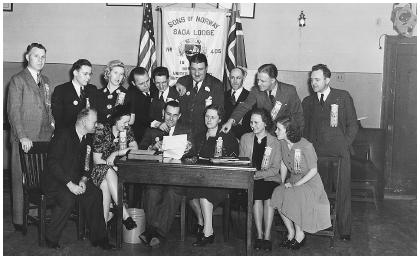
Sons of Norway members in New York in 1940, drawing up papers for a formal protest of Germany's invasion of Norway.

If Norway circa World War II, or its resistance movement are of interest to you, I highly recommend you check out the October 2008 issue of Viking magazine, or click here to read stories from the resistance that we posted on the blog last year. There's also some great articles over at newsinenglish.no on the remembrance and the release of war documents this year.

A Smorgasbord of Nordic Cinema

The Norwegian blockbuster, “Max Manus,” was highlighted in February’s issue of Viking magazine. If you live in or around the Twin Cities, now is your chance to see the WWII thriller, which sold more than 700,000 tickets in Norway. Not bad for a country of less than 5 million movie-goers!

The screening of “Max Manus” will kick off the 28th annual Minneapolis-St. Paul International Film Festival, which runs April 15-30 at St. Anthony Main Theater in Minneapolis. The film will be introduced by Norwegian resistance hero Gunnnar Sønsteby, who, at the age of 92, remains the most highly decorated citizen in Norwegian history.

This year’s film festival includes six films from Norway, plus nearly a dozen other Nordic films. Whether or not you live in the Twin Cities area, if you love the cinema, you’ll want to check out this year’s festival entries and add some to your must-see list.

Thursday, March 5, 2009

Can You Tell Me How to Get to the Sons of Norway Blog?

The other day I was taking a look at some recent visitor stats, and I noticed that the blog had become very popular with search engines on two topics: Gløgg recipes and the WWII Norwegian Resistance movement. In just the last couple months we’ve had a lot of new visitors stopping by to learn about both subjects, which I think is very cool. But then I got to wondering what other search terms were bringing visitors here. Most were pretty straightforward, like Norwegian Blog, Sons of Norway International Convention, etc.

But, in going through the list of thousands (literally) of search terms and keywords, I came across some pretty strange stuff. I found search terms that left me simultaneously laughing and scratching my head. So much so, that I thought it’d be fun to share some of the really choice keywords that have brought visitors to this little corner of teh intertubes.

With that I give you the Sons of Norway Blog’s Top 10 Strangest Search Terms!
  1. history of dark norwegians Ok…huh? Are Norwegians like Jedi now? Was someone trying to find Luke Skøywålker and Dærth Væderson? Actually, this term leads you back to the post about death of Aftenposten English.

  2. glad it's time for lutefisk again This one kinda threw me for a loop, because in the 9 years I’ve worked for Sons of Norway I have NEVER heard those six words spoken together. I’m not saying it doesn’t happen, just that it’s got to be very rare. Like seeing Bigfoot flying a UFO level of rarity.

  3. norwegian famous conga Until now I never knew that Afro-Cuban drums (or the line dance) were popular in Norway. Nor did I know that this blog was one of more than 50,000 sites that come back from the search term. Who knew that Norwegians like to get funky?

  4. drunken burping Huh? Why would anyone spend even a moment googling drunken burping??? More to the point, I’m curious if they were pleasantly surprised or disheartened when they followed the link to our blog, only to find an article about a drunk moose. Just pondering that will provide me with entertainment for the rest of the day.

  5. orange peel psychoactive properties Hmmmmm. You people are starting to scare me. This term takes the searcher to our article on Gløgg recipes, but in looking at the other pages this search returned, I’m guessing that Gløgg isn’t what they were looking for. Darn hippies.

  6. frozen death grandfather adopted norway Ok, now it’s just getting weird.

  7. norway food fish smells bad This one leads visitors back to the article I wrote in October about strange/dangerous foods in Norway. But, again, I have to ask why would someone combine these five words into a web search? I mean not all Norwegian food or fish smell bad. Take salmon for example; very tasty and very nutritious. I’m just saying, is all.

  8. nazi doctor treating rheumatoid arthritis norway …And just when I thought the frozen grandfather search would be the strangest, we get this gem. I’m not even going to touch this one other than to note that I could not replicate the search, so I have NO idea how it even ties to the blog.

  9. crown princess mette marit + ugly Oh come on now! I think the crown princess is quite fetching, actually. I mean she’s no Martha Louise (who I admittedly had a small crush on for years) but she’s certainly not ugly! You know, she got a lot of crap (undeservedly) from the Norwegian public and press when she first started dating crown prince Haakon but it’s been more than a decade! Come on people—don’t be haters!

  10. christmas fish soaked in poison Yeah…let’s really let this one sink in. Take a minute if you need to—I did. Again, this leads a visitor back to the post about strange Norwegian foods, but here it’s a little out of context. I’m almost afraid to ask what someone might be trying to accomplish with this kind of web search. However, if they read my post, they probably learned that you don’t need to soak certain fish in poison to make them poisonous. Is this a sign that I ought to be more careful about what I eat this year at Christmas dinner?
Wow, I've read through this post five times now and I'm still alternatingly shaking my head and ROTFL (just a shout out for teh kidz). This makes me curious, though, in a morbid sort of way. Are there even stranger/funnier keywords or search strings that lead to the blog? So curious, in fact, that I am going to make this into a contest!

Here's the deal: whoever sends me the strangest/funniest search terms that lead to the Sons of Norway blog will receive a free Norwegian flag keychain. You can either post them here on the blog comments, or e-mail me at eevans@sofn.com. If we get enough responses, I’ll share the funniest here. Alright, now head on over to Google and see what you can come up with! Good luck and good searching everyone!

Friday, September 26, 2008

WWII Quiz Results

Last week we started a quiz about Norway during WWII and now here are the results:

Q1: The invasion of Norway had a German name. What was that name?

The correct answer for this question was Operation Weserübung and 56% of you got the answer right!

Q2: One of the earliest and strongest statements made by a Norwegian during the German invasion of Norway was "Vi gir oss ikke frivillig, kampen er allerede i gang." Translated into English the quote says "We will not submit voluntarily; the struggle is already under way." Who originally said the quote above?

This one was a tricky one, but 25% of those who answered this question got it right when they chose foreign minister Halvdan Koht as the person to whom this quote is attributed to.

Q3: What was the name of the ship that helped King Haakon and much of the Norwegian Government escape Norway during Germany's invasion?

Great job to those of you, three quarters in all, who chose the HMS Devonshire as the great ship that helped during the escape from Norway. I guess a lot of our members are nautical buffs, huh?

Q4: During Germany's occupation of Norway, King Haakon headed a government in exile. Which Allied Power played host to the Norwegian Government?

Even though the U.S. and Sweden both played gracious hosts to the royal family at one time or another, it was in Britain where the Norwegian Government in Exile was established.

Q5: Norway's experience during WWII had a major ripple effect in Norway's future, eventually causing it to play a larger role in global affairs. After abandoning its policy of neutrality, Norway became a founding member of which organization?

The correct answer to this question was the United Nations. This question was a tricky one because Norway is also a founding member of NATO, however that wasn't until 1948. It was three years before that when the UN was founded to replace the League of Nations, with the purpose of stopping wars between countries and to provide a platform for dialogue. Norway was a founding member after abandoning its policy of neutrality. In fact, did you know that the first U.N. Secretary General was a Norwegian by the name of Trygve Lie?

More Information on the Norwegian Resistance Movement

For those of you interested in reading even more stories about the Norwegian resistance movement, there's a few great websites to check out:

Norway: War, Resistance, Peace There are some great stories from people involved in the resistance movement here.

Norwegian Resistance Museum This website is dedicated to the museum that keeps the memory of Norway's valiant fight alive.

In Their Own Words YouTube has a series of 3 great videos about the Norwegian Heavy Water sabotage.

Norwegian Resistance Here you will find some great info on the resistance.

Hero of the Norwegian Resistance This is a great article about Gunnar Sønsteby.

WWII People's War Another story from the resistance.

And don't forget, if you want to read all the stories we've run over the past week or so on the Norwegian Resistance, you can click here to view them.

Wednesday, September 24, 2008

Norwegian Resistance in WWII: Quiz

Just a reminder that Sons of Norway has a a short quiz about Norway during WWII that you can take! It's fun and quick and at the end of the week I'll be posting the correct answers so you can see how you did.

Norwegian Resistance in WWII: Escape to Sweden

Today's story comes from Leif Krisoffersen and Hanna Spiers. It's the story of Odd Westeng and Alf Bredesen who, in 1942, resolved to join the resistance. Two city boys, they disguised themselves as lumberjacks and moved to the country in eastern Norway, where for three and a half years they shuttled people along a 12-mile route to the Swedish border.


When Odd and Alf would do this, there was no exchange of names; “firm grips and open smiles sealed the comradeship, leaving no doubt that we stood for the same principles and against the same enemy.” The 12-mile trip would take the escapees to the border of Sweden, then 250 yards across to a road that would take them to a safe village. The story is told from Odd's point of view.


At dusk, with the evening breeze sweeping through the forest and the mist rising from the lakes and moors it was like a world of make believe taken out of the annals of Norwegian folklore: trolls with three heads, lurking behind the hills. As always, the last stretch before the border was the most unnerving and distressing part for the refugees. It was just as if the trolls became Germans, hiding in every bush and behind every tree. Suddenly the group heard rifle shots and a single burst of machine gun fire.


We were very close to the border now. I dropped to the ground and everyone followed suit immediately. We crawled through the undergrowth. There was no further shooting, no sound, once again the forest was still. Then, faintly, coming from the south-east, we heard the sounds of footsteps. They were coming closer and it startled everybody to hear German voices coming through the night. We saw their torch lights flickering from side to side, searching the path.


So we waited and waited, noiselessly, everyone with their own thoughts, some perhaps thinking of their homes, their loved ones or their dramatic escape through the blacked-out streets of Oslo; all wondering what might lie ahead or what might happen before they reached the safety that was only 200 yeards away.


It was a long wait, but when it ended we heard nothing suspicious from any direction. We set off and reached the road in Sweden without any further difficulty.


Brede told the escapees, “you have a mile to go to the village. Good luck to all of you.” Then they turned to us with outstretched hands, thanking us again and again. So, we parted from our friends, never to know their names.


To read another story about Odd Westeng visit The Second World War Experience Center online. And don't forget, if you want to read all the stories we've run so far on the Norwegian Resistance, you can click here to view them.

Tuesday, September 23, 2008

Norwegian Resistance in WWII: Grandmother's Jewelry

Picking up where the October issue of Viking magazine leaves off, here's another great story about a Norwegian family during WWII and the German occupation of Norway.

Christine Meseng sent in this story about something that happened as a child during WWII.

It was Christmas Eve of 1943 and my sister, parents, who were both immigrants from Kristiansand, and I were invited to a friend’s home. The friends had also invited others who had immigrated from Kristiansund and it was to be an old time party where all the furniture was pushed aside and we could dance around the Christmas tree, as they did years ago in Norway.


Our friends, the Linneruds, had invited three young men into their home for the holidays. The young men had escaped from Norway after the invasion and made their way to Toronto, Canada, where the Norwegian government had established an aviation training camp called Little Norway. These boys were training to go back to Norway and fight the Nazi’s.


My sister and I got to talking with the young men as we were the only young people that could speak Norwegian. We talked about many things in this country and eventually one of the men asked my name. When I told him he got very quiet and asked “what is your father’s name?”


I told the boy my father’s name was Christ Nygaard and he then asked where my father was from. I told him my father came from Kvernes, a small island near Kristiansund, and pointed my father out to him. The young man quietly left the room , only to return a few minutes later and walk up to my father. “Kristian Johan Nygaard, dette er fra din Mor,” (Kristian Johan Nygaard, this is from your mother) he said. With that, he handed my father a small package. My dad opened it and there lay my grandmother’s jewelry.


The young man told us that my grandparents had helped him escape from Norway. But, before he left my grandmother had given him this package and told him to give it to my father if was able to get to Chicago.


Everyone was stunned! Can you imagine how small the chances were that he would even get to the U.S., let alone find my father?


Thanks again, Christine, this was a great story of family helping the resistance movement by assisting two young men escape the clutches of Nazi Germany so they could, one day, come back to fight for their homeland's freedom.

Don't forget, if you want to read all the stories we've run so far on the Norwegian Resistance, you can click here to view them.

Monday, September 22, 2008

Norwegian Resistance in WWII: Uncle Haakon

In continuing the October Viking's feature on Norway's resistance movement during WWII, we have a great story from Tore Haugeto of Staten Islan NY about his uncle, Haakon Somerset. This is an expanded version of the story that ran on page 16 of the October Viking.

My uncle Haakon Sommerset was an elementary teacher in Oslo before WWII. He was an anti-Nazi union leader. His name was listed on the Gestapo index cards that were sunk in the Oslo fjord with the cruiser Blucher on the first day of the Nazi invasion. The sinking only saved Haakon for a short while.

You see, teachers were required to join the Nazi (NS) Norwegian teachers organization if they wanted to continue to teach. By March 1942, 98% of Oslo teachers had quit the compulsory NS teachers union. The four teacher unions protested against
Vidkung Quisling’s Nazi curriculum and they wrote a letter to Norway’s church and education department. The letter said they had to be true to their teacher call and their conscience and could not teach Nazi curriculum to the youth of Norway. 8,000 envelopes and letters were sent out to the male and female teachers throughout the land. Nearly all the teachers signed the letter.

In April, 1942, over 1,100 teachers, including my uncle Haakon, were arrested because they had quit the NS teachers union. They came from the elementary and high schools as well as professors from the
University of Oslo. The 650 male teachers were put into concentration camps in Finnmark. Reichskommisar Terboven said the teachers action was no longer and internal Norwegian problem. The Wermacht, SS and Gestapo would handle the problem.

My uncle, and 650 other teachers, were sent to
Grini, a huge concentration camp near Oslo. The next day they were put in cattle cars and sent northward. They spent 18 hours in the cattle cars before they were in Trondheim. Then they were put on the MS Skjerstad and sailed to Kirkenes. The stink on the ship was terrible. The men felt they couldn’t get enough air. The boat was stopped at Bodo for six days and the Red Cross was allowed to give the teachers some sandwiches. On April 28th, they arrived in Kirkenes, which was the most northern concentration camp on the German Reich. Kirkenes was a mining city with enormous iron ores, so it was valuable to the Nazi war effort. The Norwegian teachers then had to make a 10 kilometer march to their barracks, which were unbelievably dirty but the teachers cleaned them up. They were put on forced labor teams for 12 hours a day and received little to eat. My uncle lost 60 lbs during his imprisonment.

Because my uncle Haakon spoke German, and had been a
labor party (Arbeiterpartei) political and a union leader before the war, the other prisoners elected him to be the spokesman for all the teachers in the camp. He spoke to many German army officers at the camp, a few of whom said that it was shameful that Norwegian teachers were arrested.

Life in the camp was hard for uncle Haakon and the other prisoners. The camp was ice cold, being so far north, and the barracks walls were made of pressed paper. My uncle stole some potato sacks to make a sleeping bag, but if he’d been caught stealing the sacks he would have been shot. However, if he hadn’t stolen the bags he would have frozen to death. I

n the camp, some teachers became deathly ill, so my uncle, who headed the camp committee, advised the sick to recognize the new order and the NS so they could go home. Years later my uncle would have to write letters on their behalf to the education department, explaining these sick men and women had not really been
Nazi collaborators.

Then, in September of 1943, Quisling finally realized that he couldn’t break the teachers unions, and since the teachers were greatly needed in the schools, three hundred men were sent south again. Two months later the remaining imprisoned teachers were released. In the end, most teachers returned to their classrooms and resumed teaching their regular Norwegian curriculum.


But this was not the end of the story for my uncle Haakon. After his release from the concentration camp, he joined the
civorg (the civilian resistance movement). It was his job to collect and distribute vital information from Britain and the home front. Along with his compatriots, he had to secretly listen to British radio broadcasts and run off newspaper articles.

When the war finally ended, uncle Haakon was appointed principal of Majorstua, the largest elementary school in Oslo.


Coming up tomorrow we have a great story about a chance encounter with Norwegian resistance fighters in Chicago, Ill. And don't forget, if you want to read all the stories we've run so far on the Norwegian Resistance, you can click here to view them.

Friday, September 19, 2008

Norwegian Resistance in WWII: Invasion and the Birth of the Resistance Movement

The starting date of the war is generally held to be September 1939 with the German invasion of Poland and subsequent declarations of war on Germany by the United Kingdom, France and the British Dominions. From that point until early April, 1940, Norwegians regularly gathered in churches, on street corners and around their radios, discussing Nazi Germany's aggressions and the ambitions of their leader, Adolf Hitler.

Then, on April 9th, 1940, life would change for all Norwegians with the launch of Operation Weserübung, the invasion of their homeland by the Nazi's. The country was taken entirely by surprise and it was a time of chaos for many Norwegians. Consistent with Germany's Blitzkrieg doctrine, five divisions of Nazis invaded at once, Quisling was on the radio declaring himself Prime Minister and ordering all resistance to halt at once and the Norwegian military was left in a state of initial disarray due unclear mobilization orders from the government. The whole of the country was in a state of psychological shock from the Nazi invasion.

But, even in these darkest of times there was still a glimmer of light. With a speed and urgency to match Germany's Blitzkrieg tactics, Norway endeavored its own resistance movement. Greatly outnumbered and with few physical resources at hand, many Norwegian citizens banded together to do everything they could to protect their homes, their families and their cherished way of life. Check back all next week to read posts about Norway's resistance movement during World War II and some first-hand accounts from our members.

Thursday, September 18, 2008

World War II Quiz

Since we'll be running the series on the Norwegian Resistance Movement during WWII, I've put together a short quiz for all you history buffs! I'll post the correct answers next Wednesday, so you can see how you did. Enjoy!

Norwegian Resistance in WWII

The October issue of Viking magazine ought to be arriving in members home's this week and I can promise it's going to be a great issue! The feature I'm most excited about deals with members stories and experiences with Norwegian Resistance Movement during the World War II Nazi occupation.

When we reached out to our members a few months ago, asking for their stories, we had no idea there would be so many. In fact, we received more responses than there was room for in the magazine! So, for the next week or so the blog is going to be running a multi-part series retelling members' stories about resistance movement and their WWII experiences. We'll have posts about what happened during and after the German invasion and providing other interesting bits of information about Norway's struggle for independence from the Nazis.

We hope you'll enjoy the series. If you have stories of your own about Norway during WWII or the Resistance Movement, let us know about it because we'd love to hear your story. You can either post your story in the comments section below any of these posts, or you can e-mail them to me at sonsofnorway@sofn.com and I'll be happy to post them.

Monday, September 15, 2008

Monday

Just a couple more days until Colin and Nichole are ready to debut their first blog posts. But until then, we're going to have a little trivia contest. Here's how it goes:

In preparation for next week's series on member stories about the Norwegian resistance movement during World War II, we've put together a 5 question quiz about Norway during its occupation. You can take the quiz here and then make sure to check back on Friday to see the correct answers!

Have a great Monday everyone!