Showing posts with label Norwegian Language. Show all posts

Friday, August 27, 2010

The World is Your Language Lab

Want to brush up on your Norwegian vowels? Check out this video clip that runs through the pronunciation of all nine. (In case you’re wondering, they’re presented in the following order: I, Y, E, Ø, A, Æ, Å, O, U.)

Thanks to all the great resources on the Internet, it’s easier than ever to learn—or dust off—a foreign language. When I was studying Norwegian in college, I remember going to the language lab, putting on the headphones and listening to recordings of folk tales while I read along. Now it’s easy to find resources such as Norwegian radio stations, TV programs, movies and newspapers—all without leaving your desk.

You can also find a mini language lesson, called “Spread the Word,” in Viking magazine each month. It’s in our newly redesigned Nordic Life department. It’s just for fun (there’s no final exam), so enjoy!


Amy Boxrud is editor of Viking magazine. She lives with her family in Northfield, Minnesota, where she’s a member of Nordmarka 1-585. Amy is a Nordic folk music enthusiast, and when she’s not working or parenting, she can often be found making music with friends.

Tuesday, June 22, 2010

Hilsen fra Skogfjorden

I’m writing from Skogfjorden, Concordia College’s Norwegian Language Village, near Bemidji, Minnesota. I enjoyed working as a counselor at Skofjorden throughout my college years, and it’s been a huge treat to return for a stint as an alumi staff member the past two summers. It’s particularly satisfying to be here with my son and daughter, ages 9 and 11, and to watch them enjoy many of the same experiences that I did as a child at the language village.

The program enjoys a high return rate year after year and the staff encourages youth to participate for ten summers, or gå for ti! In the summer of 2009, 10 participants earned their 10-year awards, thanks, no doubt, to generous support in the form of Sons of Norway scholarships to many Skogfjorden families.

So what’s happening at Skogfjorden this summer? Plenty! In 2010, special emphasis will be devoted to three topics: music, peace studies and folkehøgskoler (folk high schools). Students who spend four weeks at Skogfjorden, earning a year of high school language credit, will be studying the themes of oil and energy. Finally, the staff will give special emphasis to the life and work of Bjørnsterne Bjørnsen, who also is celebrated throughout Norway this year. Of course, at the heart of all the programming is the Norwegian language immersion experience.

Check out this fun video of Skogfjorden staff member Hans Erik with two day-camp participants.


Amy Boxrud is editor of Viking magazine. She lives with her family in Northfield, Minnesota, where she’s a member of Nordmarka 1-585. Amy is a Nordic folk music enthusiast, and when she’s not working or parenting, she can often be found making music with friends.

Saturday, June 19, 2010

Today we're gonna party like it's nitten nittini!

I know Norwegian language is always a favorite subject so how about a quick chart about Norwegian numbers?

Don't mind if I do!

Thursday, March 25, 2010

"Uff da!" Defined

My maternal grandparents, both second-generation Norwegian Americans, sprinkled their conversations with “uff da” and “nei da” as liberally as they used sugar cubes in their coffee. So it was fun when, skimming Sunday’s Star Tribune newspaper, I came across Karen Youso’s column: “Uff da! What it means, when to use it.”

She defines “uff da” as a “Scandinavian expression used to express compassion, empathy or annoyance.” Youso says “nei da” is “used to show surprise or shock in a negative way or when something unbelievable happens.” She also gives a definition for “fy da,” saying it expresses disgust, revulsion and horror. She even gives examples of when each saying is appropriate: “You use ‘nei da’ if your property taxes go up 100 percent.”

I clearly remember Grandma comingling the sayings to become “nei fy da” and “uff da nei.” In fact, my brothers and I still use her hybrid sayings in mock horror or frustration when, for example, we’re playing cards with each other and our partner makes a lousy play.

I’d love to hear if these Scandinavian expressions—or variations of them—are alive and well in your family’s lexicon. Email us at vikingeditor@mspcustomcontent.com.

Monday, January 25, 2010

Eurovision

Here's another post from Nichole about the 2010 Eurovision competition!

Is it really that time again? Indeed, Eurovision qualifying competitions are heating up all over the world, with a lot of action seen in Norway. Contestants are starting to compete for a spot in the Melodi Grand Prix, which qualifies a Norwegian contestant for the international Eurovision competition. You can follow Norway’s progress here.

You’ll recall that the Sons of Norway blog followed last year’s competition, won by Norwegian Alexander Rybak. (Archived posts here and here). But there’s even more reason to keep our eyes on the 55th annual contest as the days progress – the lucky national winners all head to Oslo for the final competition in May!

Check back for updates on Norway’s progression in this fun contest of song.

Thursday, October 29, 2009

Nordic vs Scandinavian: The Terms That Launched a Thousand Ships

Today we've got a great post from Colin, clarifying a point that has confused many folks (myself included).

A recent post on this blog generated some comments about the cultural connections between Scandinavia and Finland. The discussion brings up an interesting issue about the distinctions between Scandinavians and their eastern neighbors.

In America, the words “Nordic” and “Scandinavian” are used more or less interchangeably, but there’s a distinction between them that’s worth making. Strictly speaking, “Scandinavian” is a term referring to people who share a common Germanic linguistic and cultural ancestry, and live in or come from the countries we now know as Norway, Sweden, Denmark, Iceland, and the Faroe Islands. The term “Nordic” is meant to encompass a larger group of people living or coming from a geographic region, roughly defined as stretching from Finland to Iceland, or even Greenland, depending on the context.

Scandinavians are the linguistic and cultural descendents of tribes of wandering Germans who ventured north as the last glaciers receded. Even today, their languages are very similar and to a great degree, mutually intelligible. Finnish, on the other hand, is completely different, and is far closer to Hungarian than any of the Scandinavian languages.

Despite the linguistic divide, there has been a long history of cultural and political connection between Finland, Scandinavia, Greenland and, for that matter, the Baltic states of Estonia, Lithuania and Latvia. Over the centuries, various groups have invaded, conquered, colonized, fled, migrated to and been pushed out of each other’s countries, the borders of which have changed significantly through history. Thus, the ethnic and cultural makeup of the Nordic region is far more complex than people commonly think. There are Swedish-speaking people in Finland, Finnish-speaking people in Sweden, ethnic Danes in Greenland, the Eskimo-Aleut Greenlanders, the Kven people in Northern Norway, various groups of Roma (gypsies) throughout the region, immigrants from all over the world, and of course the Sami, who might be related to the Finns, but maybe not – no one really knows for sure. The term “Nordic” is convenient, if not tremendously specific, because it lumps all of these people more or less together.

In America, we’re fairly inconsistent about how we use these terms. Your typical “Scandinavian” gift store will also include a good number of Finnish items. At the University of Minnesota, I studied Norwegian under the aegis of the Department of German, Scandinavian and Dutch, although the same department also offers Finnish; this is reflected in that my major is known as “Scandinavian Languages and Cultures and Finnish” which is misleading given that, unfortunately, the closest I ever got to studying anything remotely Finnish was to read The Finn Family Moomintroll, a children’s book series written by a Swedish-speaking Finn. On the other hand, the Nordic American Thanksgiving Breakfast event is dutifully so titled because it includes representatives from the Finnish-American community, and various incarnations of Sons of Norway’s mission statement have taken pains to make the distinction: The mission of Sons of Norway is to promote and to preserve the heritage and culture of Norway, to celebrate our relationship with other Nordic Countries, and provide quality insurance and financial products to our members.

Tuesday, October 20, 2009

It's Never Too Early for Norwegian Language Lessons

Good morning world! It's still dark outside on this cool October Tuesday, so the creative/mental juices are still moving a little slowly. On days like this I look for inspiration in an number of locations. First I go to the blog stats and see what folks are interested in reading about (language and food) then I go out into the wilds of the web, looking for content that I think you'll enjoy.

Today's wonderstuff comes from the awesome folks over at My Little Norway, another blog about Norway. I love it because it's written from the perspective of a foreigner living in Norway, so there's lots of interesting topics, which I always find entertaining and worth the read.

Seeing as how many of this blogs readers really enjoy reading about Norwegian language, I thought many readers might be interested in some posts by L-Jay about how the Norwegian Language has affected English. Enjoy and check back late for some original content.

Tuesday, July 14, 2009

Allemannsretten – the Freedom to Roam

Today we've got a great language post from Cultural Advisor, Colin about the word "Allemannsretten." Enjoy!

For all the similarities between Norwegian and American culture, I am perpetually fascinated by the differences, sometimes small and sometimes gaping, that I occasionally stumble across. One of the most interesting to me is the Norwegian concept of allemannsretten (ALL-eh-mahns-ret-en). Literally meaning “everyman’s right,” allemannsretten is also called “the freedom to roam” in English. Simply defined, allemannsretten makes it legal in most cases for people to walk through any piece of undeveloped private property without first obtaining the owner’s permission. You can even camp on someone else’s private property for one night, provided that you’re polite and stay at least 150 meters away from any buildings. In the US, we call this trespassing – I’ve been told that in some states it’s actually legal to shoot people for it – but in Norway (and a few other countries in Northern Europe) it’s a common law tradition that’s been around for a very long time.

Allemannsretten is not unlimited. Norwegian law makes a clear distinction between cultivated land (innmark) and uncultivated land (utmark). The law defines cultivated land as “farmyards, plots around houses and cabins, tilled fields, hay meadows, cultivated pasture, young plantations and similar areas where public access would unduly hinder the owner or user.” Pretty much anything else is considered to be uncultivated land. Cultivated land can be crossed on foot when the ground is frozen or covered with snow, although not during the period between April 30th and October 14th. What’s most interesting to me is that the law explicitly states that travelers making use of allemannsretten have to behave themselves. All users are expected to leave the area in the same condition they found it, and property owners have the right to eject campers, hikers or sunbathers who are being annoying or causing damage. You can read the entire law, in English, here.

While not exclusive to Norway, I first explored the concept during my first visit to the country several years ago. I was on the island of Stord, in Western Norway, traveling with relatives to visit some ancestral farms. This was mid-May, so between the jet lag, the excitement of being in Norway, and the near-constant sunlight, I was finding it very difficult to sleep. One night, long after my relatives had gone to bed, I decided to make the most of my insomnia by walking from downtown Leirvik, where we were staying, into the hills outside of town. There’s a network of well-traveled trails there, and I soon I found myself enjoying a pleasant stroll through the silent forest, alone in the stillness of the seemingly eternal Nordic twilight. I walked what I considered to be a moderate distance, probably just a few kilometers, when I came to a map. There I saw that my only reasonable options for getting back to the hotel were to backtrack or to cut through the woods, bushwhacking off of one trail to get to another. I never backtrack if I don’t absolutely have to (lots of my stories start this way) so off I plunged into the brush, remembering what I had read in my guidebook about allemannsretten.

This plan worked…moderately well. I could not have known that the backwoods of Stord are an excellent environment for a particularly thorny variety of holly, which covers the forest floor like rows of razor wire. (I could not have known, that is, unless I’d been paying more attention, as the holly bow is used as the sole motif of the community logo, which was in evidence all over town.) As I plowed through the undergrowth, the vicious little shrubs slashed my bare arms and legs, even drawing blood, but, being stubborn, and more or less surrounded but the stuff, there was nothing to do but keep going through it. Eventually I came to a particularly vast stand of holly, and decided to go around it, even though I could see this would take me close to the edge of the forest near some houses. I knew that at the forest edge I was still protected by allemannsretten, but given the late hour, I was very eager to avoid attracting attention to myself, so I decided I had better run until I was clear of the houses. Alas, I looked over my shoulder at the wrong moment, tripped, and landed face first in a huge holly bush. As I painfully extracted myself from its prickly embrace, I looked up and saw that I was in full view of the owner of a small house who, by happenstance, was clearly wide awake and working on some sort of carpentry project (evidently I was not the only one having trouble sleeping). The midnight carpenter looked up and regarded me, now covered in mud, lacerated and deeply embarrassed, with a look of weary disdain. Much to my relief, he simply shook his head and went back to work. Allemannsretten may obligate property owners to tolerate hikers, but it doesn’t force them to save anyone from their own stupidity. A valuable lesson.

Friday, July 3, 2009

Kvinesdal Emigration Festival: Day 1

Today's events for the Kvinesdal Emigration Festival include a Grand Re-Opening ceremony for the Lister Emigrants Museum. Here's some video of Mayor Omland og Thoralf Haugland at the ceremony. Here's some video of Toralf Haugland opening the festivities.

Then, in about an hour or so (9:30 p.m. Norway time) there is going to be a get-together of Sons of Norway members who are in town for the celebration. I may get a report afterwards, so make sure to check back in a few hours to see if we have more info about todays happenings.

Kvinesdal Emigration Festival: Prelude

Today is the beginning of the Kvinesdal Emigration Festival being held in Kvinesdal, Norway. Sons of Norway's Interim CEO, Eivind Heiberg is over there now preparing to give a welcome speech. I've had the good fortune to have seen an earlier draft and it's going to be great. I believe he's going to talk about Norway and America's strong relationship and how emigration has created a bond between the two countries and intertwined their modern histories together.

This, I think, is a very unique experience for modern countries like ours. I mean, even in this age of globalism, there is still an overriding sense of isolation amongst first world countries, making them more business partners than brothers and sisters. Thanks to our shared histories, U.S. and Norway, however, have a relationship more like the latter than former. Definitely something worth celebration, don't you think?

Uh...ahem...[quietly steps down from pulpit]

Anyhow, this is a very unique and special festival. I'm glad Sons of Norway is participating. I spoke with Eivind yesterday about his experiences so far and as of last night he'd had dinner with Toralf Haugeland, one of the main organizers of the festival, and some film makers. I guess that in addition to a good meal they discussed the possibility of our acquiring some new, hard to get, fils for our media lending library. That'll be very cool!

In the mean Eivind sent some video of the Utsikten hotel. Here's some video of the hotel itself. Then, in this video and in this one, too, you can see why the hotel is call Utsikten (translated to English means "the view").

Ok, more later about today's festivities, including the grand opening ceremonies for a new wing on the Listes Emigration Museum.

Thursday, July 2, 2009

Språk og kultur / Language and Culture

Today we've got a great post from Cultural Advisor Colin Thomsen, wherein he discusses the meaning of the Norwegian word, nærgående.

nærgående (adjective)
prononunciation: nair-GO-en-eh

There’s no way to sum up the meaning of the Norwegian adjective nærgående with just one word in English. To say that someone is nærgående is to say that they are a little obnoxious, too personal, or too interested in other people’s business. The person who tells you their whole life story in line at the supermarket? You could call them nærgående. The nosy neighbor who asks how much you paid for your new car? Nærgående again. Translated literally, nærgående means ”close-going” and the fact that it’s used to describe such people shows that in Norwegian culture, it’s polite to maintain a little more personal distance than what most Americans are used to. While Americans are generally accustomed to making small talk with total strangers, that’s much less common in Norway. For example, while many Americans (especially Midwesterners) are known for greeting strangers passing on the street, the Norwegian custom is to walk by without saying a word or exchanging a glance. Even clerks and waiters – to make a broad generalization – rarely go out of their way to chat with their customers. But it’s not that Norwegian society is unfriendly, it’s that the standards of when it’s appropriate to be friendly are a little different. If you meet an acquaintance on the street in Norway, the general expectation is to stop and have a fairly involved conversation. For Americans, to tell a friend “we should get together some time” doesn’t necessarily call for making a plan. For many Norwegians, it sounds like an invitation. Friends and family are treated with special attention in Norway, and if you’ve ever spent a holiday with Norwegian relatives, you know what that means. And that’s not nærgående at all.

Wednesday, July 1, 2009

Production has Started on a History Channel Documentary about the Kensington Runestone

I just got confirmation that there is a new documentary, focusing in part on the Kensington Runestone, in production over at the History Channel. According to reports Committee Films, along with a crew of about 30, spent the day at Kensington Runestone Park recently – filming the story of the Kensington Runestone.

From what I understand about the documentary, the main story revolves around a new theory that the Kensington Runestone may have been a coded message related to the Knights Templar, rather than Viking explorers. Apparently stones with similar markings have been found on the east coast and across the Atlantic, implying that there may actually be something to the authenticity of the artifact.

Supposedly this documentary is even speculating that if the Templars are behind the Runestone there may be a chance that they also brought the Holy Grail over with them.

Yeah, I think it’s a stretch, too. But whatever, if researchers can prove the stone is actually from the 1300’s as has been posited, then it’s one more example of pre-Columbian exploration of the new world. An idea that science has been slow to recognize as both possible and probable.

What’s that? You aren’t familiar with the Kensington Runestone? Oh, well here’s the skinny:

The Kensington Runestone is a slab of greywacke covered in runes on its face and side which, if it is genuine, would suggest that Scandinavian explorers reached the middle of North America in the 14th century. It was found in 1898 in the largely rural township of Solem, Douglas County, Minnesota, and named after the nearest settlement, Kensington.

Depending on who you ask, it could be a 19th century forgery or an important archaeological find from the 14th century. Those who ascribe a Scandinavian origin to the stone claim it shows evidence of obscure medieval runes and intersecting word forms that would have been unknown to potential forgers in the 1800s. These advocates tend to be enthusiastic but often lacking in professional credentials (Viking-origin proponent Keith Massey holds a Ph.D. from the University of Wisconsin-Madison, where Erik Wahlgren taught). Interested professional archaeologists, historians, and Scandinavian linguists generally question the stone's provenance.

Here's a good video on the Runestone and some info on its possible link to the Knights Templar. Anyone have any thoughts on what the Runestone could be? Share them in the comments section.

Thursday, June 11, 2009

Russ (Rhymes with Moose), or You Thought Senior Prank Day Was Bad?

We've got a really interesting article today from Nichole about the yearly Norwegian happening, called Russ. Enjoy!

As schools across the US begin to wind down, we thought it might be an apt time to expose our members to an interesting Norwegian end of schooling tradition…

Right about now, you’ll see stories on Aftenposten, detailing the fall out from the annual Russ celebrations.
Q: What is this Russ celebration?
A: One of Norway’s most confusing (IMO) and entertaining pastimes.

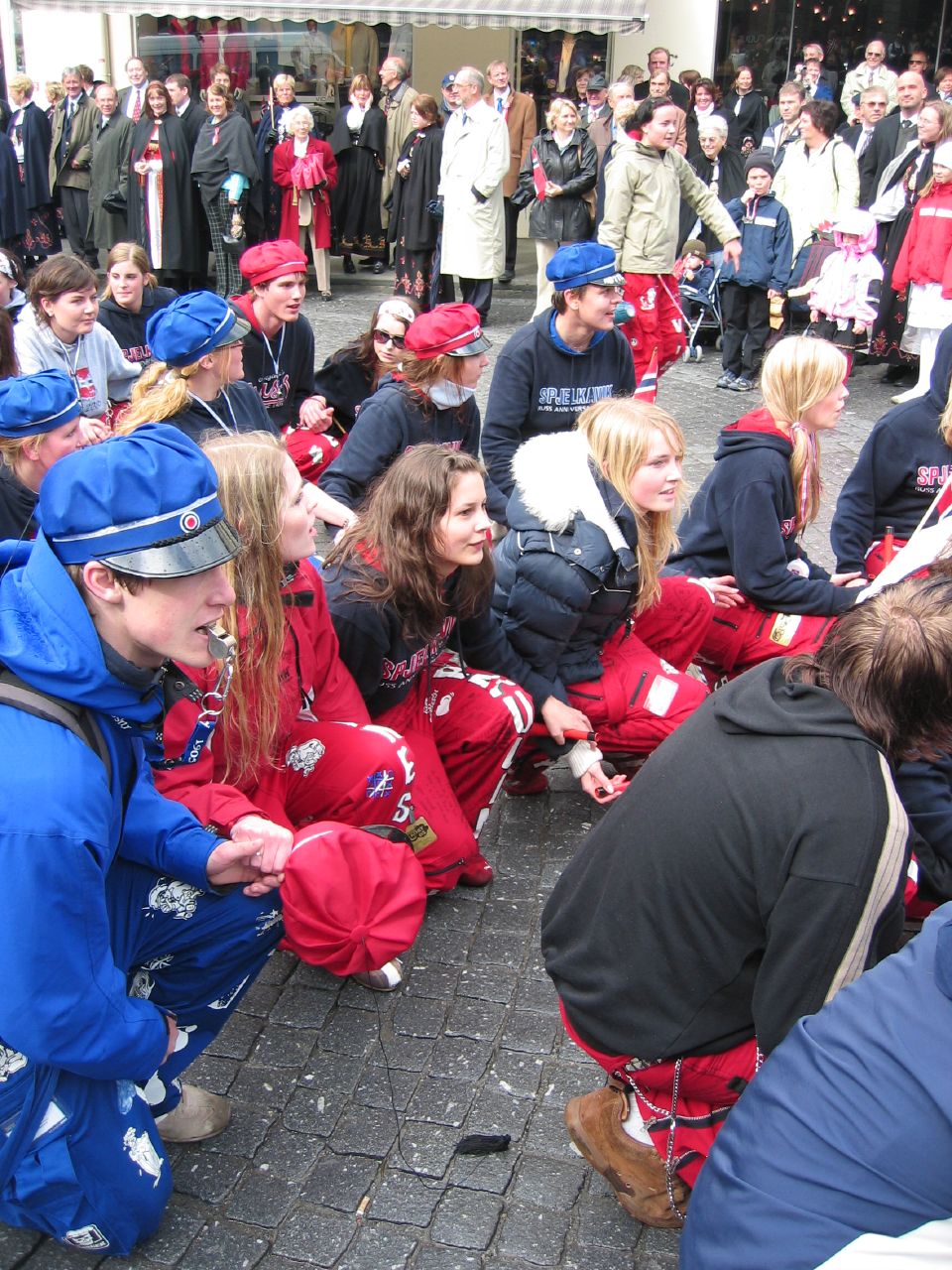
This annual tradition (russfeiring or russ celebration) surrounds the graduation of students from secondary school, who are preparing to enter university. The most striking visual component to this celebration is the red (for school of arts) and blue (for economics) coveralls that the graduates wear. Tradition dictates they wear these for over two weeks at the beginning of May.

While the donning of the coveralls marks an important rite of passage for these young adults, it can often mean mayhem for the communities of the graduates. These youngsters receive knots, which dangle from their russ caps, that connote the completion of different outlandish tasks (examples can be found in the articles).

In recent years, Russ have spent thousands of dollars outfitting party busses and pulling elaborate pranks. Communities, which would otherwise condemn their loud and constant partying seem, for the most part, to accept the weeks as an earned tradition for the students.

Next time you see Fraternal Director Eivind Heiberg, ask him about his experiences with as a Russ. Most certainly, he’ll have a yarn or two to share…

Russ in pictures:
(search hard and you can even find a picture of young HRH Crown Prince Haakon!)

*Some of this information was obtained from Culture Shock! A Guide to Customs and Etiquette by Elizabeth Su-Dale.

Saturday, May 23, 2009

Chief Wiggum – Norwegian American?

Today we've got another post from Colin, this time discussing Norwegian names, The Simpsons and speculation on Clancy Wiggum's heritage. Have a great weekend everyone!

We’ve already written about Sunday’s Simpsons episode marking Syttende Mai – click here to read it if you missed it – and that reminded us of my own (unproven, highly speculative) theory about the ethnic background of Springfield’s police chief. Namely, I think that Police Chief Clancy Wiggum is a Norwegian-American.

Here’s why. I read somewhere that Matt Groening, the creator of the Simpsons, is half-Norwegian. If that’s true, it must be on his mother’s side, since Groening doesn’t look like a Norwegian name to me. According to this article from the Oregonian, Chief Wiggum is named for Groening’s mother, whose maiden name was Wiggum. That name looks more Norwegian to me, (because of the “wig“ part, more on that later) but then again last names change a lot when people immigrate, so it could come from anywhere. According to Statistics Norway’s database of Norwegian names, there isn’t anyone in Norway today with the last name “Wiggum” with two “g”s, but I see in my dictionary of Norwegian last names that there’s a similar surname with just one “g.” When I look up “Wigum” in Statistics Norway’s database and gulesider.no, the online phone catalog, I get over 120 hits.

So, if Matt Groening’s mother is of Norwegian descent and her last name is Norwegian, then I think we can safely conclude that Chief Wiggum is a Norwegian-American.

And now that we’ve established that, let’s not tell anyone, okay? If they actually portrayed Wiggum as a Norwegian-American on the show, we’d never live it down.

In an effort to make this post a little more educational, let’s get back to why “Wiggum” looked Norwegian to me. The first part, “wig-“ is an old spelling of the modern Norwegian word “vik” meaning “bay” or “inlet.” Because of the many changes Norwegian has gone through in the last couple hundred years, Norwegian names use lots of ways to spell “vik” (Vig, Viig, Wig, Wiig, Viik, Wik, Wiik). Many Norwegians take their last names from the farms where they or their ancestors lived, and given that Norway has so much coastline the “vik” element (in various forms) is extremely common in surnames.

Thursday, May 21, 2009

Syttende Mai in Brooklyn!

Today we have the promised post from our own Nichole who was on hand for the Syttende Mai celebration in New York this past weekend. Enjoy!

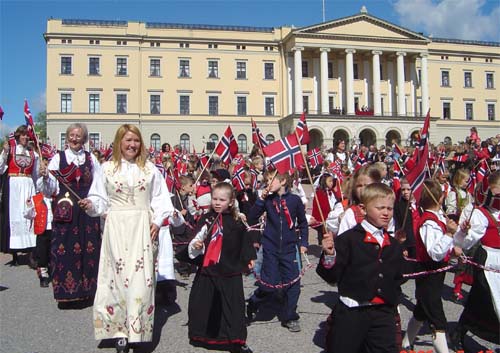
Ah, it seemed a cool day when setting out for Bay Ridge, Brooklyn, but once taking in the sights there, I forgot all about the weather! For just over two hours in the afternoon, hundreds of Norwegians (and those with Norwegian leanings), took to the streets to celebrate Norwegian Independence with a fantastic parade.

Cheers of “Hurra, hurra for Syttende Mai!” broke out spontaneously on the street with some frequency, with smiling bystanders joining in the fun and festivities. Tons of Norwegian flags lined the streets, waving at the marchers and parade participants. Even street vendors seemed to get in the spirit.


These are a few of my favorite photos from Sunday’s celebrations.

The modern and the traditional:


Representing District 3 with, um, zeal, Roy Berntsen:


And, who knew the Scots were so supportive of Norwegian Independence? This is one of the two(!) bagpipe ensembles marching for Syttende Mai.


It was great to see so many of our international officers and District 3 officers and lodge members. Check back on the blog later this week and next for some video of this great event, as well some lovely photos of the Sons of Norway youth contribution to Syttende Mai Brooklyn!

Wednesday, May 20, 2009

The Simpsons Strike a Chord on Syttende Mai

Did anyone happen to catch last Sunday's episode of The Simpsons? If so, you were treated to a special Syttende Mai treat as the episode had Norwegian immigrants "from Ogdenville" as the main focus of the story line. In truth, Matt Groening was making a commentary on U.S./Mexico immigration issues, but he supplanted Norwegians in the place of Mexican immigrants.

After watching the show, I got to thinking about whether Groening, the Simpsons creator, may have also been tipping his cap to the way Norwegians were treated in the early days of their mass immigration to the U.S. I mean, the fact that this episode ran on Syttende Mai couldn't have been a coincidence, right? It got me so curious, in fact, that I asked Colin, our man in the "cultural" know at Sons of Norway HQ, whether or not Norwegians had ever suffered from discrimination due to their immigrant status?

After looking into the subject a bit, here's what he found:

Not so long ago, Norwegians, Scandinavians and other Northern Europeans did indeed experience a degree of discrimination right here in the United States. In fact, the very existence of Sons of Norway is, in a sense, a product of discrimination against these new Americans. You see in the late 1800s immigrants were generally barred from buying life insurance, and so the organization was founded to provide basic financial protection to people who otherwise couldn’t get them.

Like other immigrant groups throughout history, Nordics were selected for the most difficult and dangerous jobs that other workers didn’t want. Specifically, Norwegian immigrants worked in shipping, fishing and logging; later many Finish immigrants found work in the logging camps and mines of Northern Minnesota and Michigan; and a mainly Swedish workforce in Minnesota built James J Hill’s railroad empire. In fact, Hill, a legendary tycoon, was so fond of his cheap Swedish workforce he once said of them, “Give me snuff, whiskey and Swedes and I can damn well build a railroad down to hell.” Some native-born Americans viewed the new workers from across the sea with resentment, calling them “squareheads” or “scandihoovians.”

Then, in the period around World War I America was stricken by a pandemic of anti-immigrant hysteria. Immigrants of all nationalities were ridiculed in public and the press by intolerant “nativists” who felt that America belonged only to them. Norwegian-language newspapers, for example, were targeted under the suspicion that they might be stirring up anti-war or anti-American sentiment. Many immigrants adopted American names and stopped speaking their native languages altogether.

Another particularly disturbing example of this happened in my home town, Duluth, Minnesota, in 1918. A group of vigilantes calling themselves the “Knights of Liberty” lynched a Finnish man, Olli Kinkkonen, from a tree in Duluth’s Lester Park, just blocks from where I grew up. Believing him to be an anti-war agitator the mob dragged Kinkkonen from a boarding house, tarred and feathered him, then hung him from a tree. You can read more about Olli’s story here.

At the same time Scandinavian immigrants benefited enormously from the opportunities afforded to them. Most Norwegian and Swedish immigrants arrived during the latter half of the 19th century, when America needed hardworking people to head west and settle the rapidly-expanding country. Of key importance was the passage of the Homestead Act in 1862, which gave away at least 160 acres to anyone if they simply lived on the land and developed it. Norwegians, Swedes, and Danes settled especially in the Midwest and participated eagerly in American society, getting involved in local government and founding schools and churches. They also formed Sons of Norway and other organizations like it, so that they could maintain and celebrate the heritage and culture of their old country while making the transition to their new one.


I was amazed at everything that Colin found. I had no idea how prevalent discrimination against Scandinavians was here in the U.S. and I think it's a very interesting topic that a lot of folks may not know about. Now, I'm guessing The Simpsons were trying to make a little different point, about showing a little more tollerance towards newly arrived citizens, but I like to think the show was also giving a wink to the interesting history of Scandinavians in America and celebrating their successes.

Today in History: Ingvar Ambjørnsen-Haefs

Today is the 53rd birthday for the famous Norwegian author, Ingvar Ambjørnsen-Haefs. Doesn't sound familiar to you? Well he's the guy who wrote the books Utsikt til paradiset, Fugledansen, Brødre i blodet and Elsk meg i morgen.

Still doesn't ring a bell?

What if I told you that those four books comprise the "Elling Trilogy" (nevermind the fact that a trilogy is technically supposed to be three)? Getting warmer? Yeah, Ingvar is the guy who wrote the story that eventually became the 2001 Oscar nominated movie, Elling. The story is a very quirky, fun and emotional one that most people would enjoy. In fact, when the film was released here in the U.S. the Sons of Norway hosted a premiere at the Lagoon Cinema in the fashionable Uptown Neighborhood of Minneapolis, MN.

Also, for those who have already seen the Norwegian version of the film there were plans as late as 2004 for an English version to be filmed. At the time Kevin Spacey was attached to produce and to play the title role. Unfortunatley, due to a number of issues that film was not to be. Too bad.

For those of you who are interested in seeing the Norwegian version, which I highly reccomend, call the Sons of Norway HQ and ask for Colin in the Media Lending Library. He can help you check out Elling, or one of our many other films, for a lodge event.

Sunday, May 17, 2009

Hurrah for Syttend Mai!


Today millions in Norway, the U.S. and Canada are celebrating Norway's 195th Constitution Day, also called Syttende Mai (17th of May). The celebration marks the signing of Norway's constitution in Eidsvoll, which declared Norway to be an independent nation.

Celebrations are happening today in most major U.S. cities and if you want to see what's going on in your neck of the woods, check out the Events Calendar at sonsofnorway.com.

Wednesday, April 8, 2009

Sons of Norway Summer Camps

Spring is here! The snow is (mostly) gone up here in Minneapolis and thoughts are beginning to turn towards making summer plans. For hundreds, maybe even thousands, of our members that means registering for one of a dozen different language and heritage summer camps that are sponsored by different Sons of Norway districts.

The camps are awesome. Each one is held in a beautiful location in the U.S., Canada or Norway and the scenery always adds to the campers' experience. Also, while each camp is a little different in ages of campers and size they all offer a strong emphasis on Norwegian Heritage and Culture. To learn more about them, visit the Sons of Norway website, or read more about them in Viking magazine.

Monday, April 6, 2009

Norwegian Music on the Internet

Recently I was reading an article about Norwegian songstress Kristin Asbjørnsen when I noticed that she has a Last.fm channel dedicated to her and other Norwegian musicians. I've been listening to it all morning and am really getting into it. I've been listening to Dadafon, Helene Bøksle and even Silje Nergaard's cover of Dream a Little Dream.

For those who haven't used it yet, Last.fm is something of an online radio station in that it streams music to the listener, but it's more than a radio station because you can get fairly specific with the type of music you'd like the site to play for you. I highly reccomend it, especially if you are looking for a resource for Norwegian music.

Speaking of which, I also found out about Lytte.no (which translates to "listen"), a Norwegian website with links to a whole bunch of Norwegian terrestrial radio stations that also stream online. There's everything from NRK P1-P3 to Sami Radio to NRK Super, a station with programming for children.

And if that's not enough for your musical tastes, don't forget about the blog post we ran a few months back about Norwegian Musicians on Myspace.